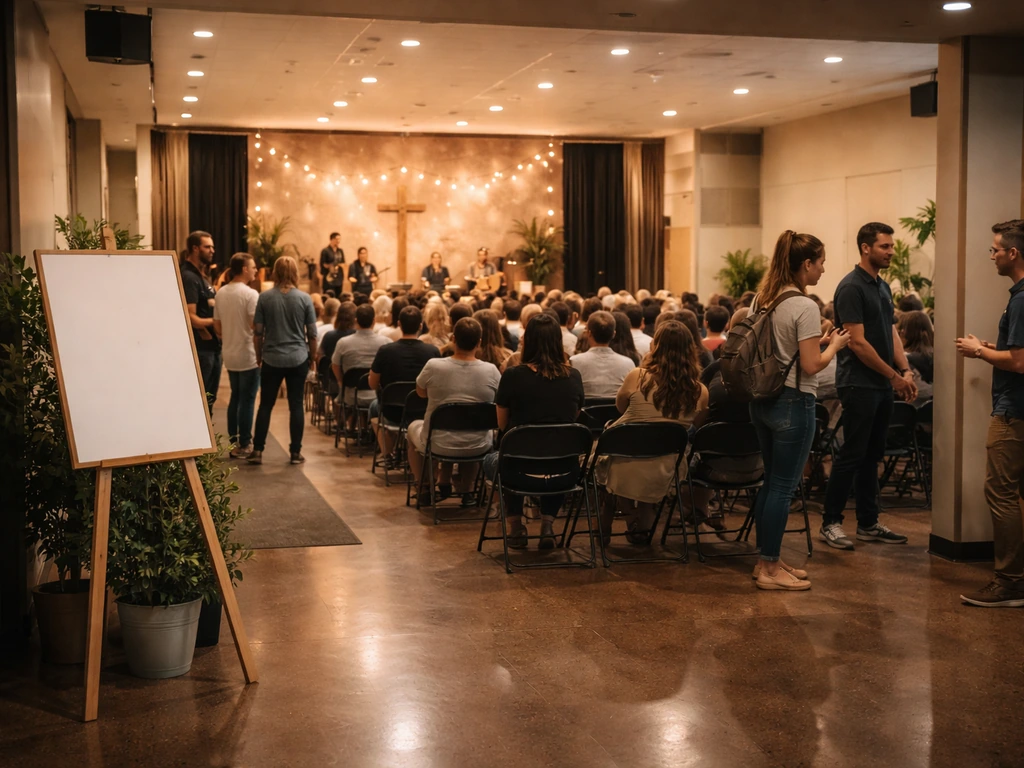
The most common models you'll run into are: (1) from-scratch plants, where a planter and a tiny team start with no people and no infrastructure; (2) launch plants, where a sending or mother church provides a core group, some funding, and ongoing accountability; (3) multi-site expansions, where an established church opens a new location under its own brand and leadership pipeline; and (4) organic house church networks, which stay intentionally small and multiply by spinning off new groups rather than scaling a single gathering. Know which one you're doing before you build your plan, because the milestones and pressure points are genuinely different.
Throughout this guide, the advice applies most directly to the from-scratch and launch-plant models, since those are where most planters find themselves. Where the path diverges for multi-site or house church contexts, I'll flag it. The core principles, though, are the same regardless of model: you need the right people, a clear vision, repeatable systems, and a genuine commitment to relationships.

No church plant grows on the strength of one gifted leader. The first thing you need to do is build a core team, and the quality of that team matters far more than its size at the beginning. Think of this core group the way you'd think about root structure in a plant: if the roots are shallow or tangled, the whole thing is fragile no matter how impressive it looks above the soil.
One of the best frameworks I've seen breaks the planting process into three phases: Prepare, Plant, and Healthy Growth. The Prepare phase is entirely about alignment: getting the right people around you who share your leadership culture, understand your theology, and have a clear relationship with a sending church or network.
Crossway Network's church plant pathway recommends building toward a launch team of at least 30 adults before going public. That number isn't arbitrary. It gives you enough people to run a worship team, staff children's ministry, greet newcomers, and still have a full room that feels alive rather than sparse. Trying to do a weekly public service with eight people is one of the most common and demoralizing mistakes new planters make. It burns out your small team and gives visitors a first impression that is hard to recover from.
Recruit for specific roles from the start: worship leader, small group leaders, deacons or care team members, a finance person, and someone who can handle communications and administration. These don't all need to be paid staff. Most early church plants run entirely on volunteer labor. What matters is that each role is named, someone owns it, and there's a clear handoff when that person needs help. Vague roles create gaps that the lead planter ends up filling personally, which leads to burnout fast.
For recruiting, start with your existing relationships: people from your sending church, your neighborhood, your professional network, and your family. Be direct about what you're building and what you need. Most people won't join a church plant because of a flyer or a social media post. They join because someone they trust personally invited them and cast a compelling vision. Don't be shy about making that ask.
Vision, strategy, and starting plan
Your vision is the single most important communication tool you have in the early days. It has to answer three questions clearly: Who are we trying to reach? What kind of community are we building? And why does this city or neighborhood need this specific church? If you can't answer those in two or three sentences that a normal person understands, keep working on it.
Once you have a vision you can articulate, build a written starting plan with a real timeline. Vague intentions don't produce results. A good starting plan includes: a target launch date, monthly milestones for the 12 months leading up to it, clear role assignments, a budget (even a rough one), and defined criteria for what 'ready to launch' actually looks like. Working backward from your target public launch date is often the clearest way to build this. If you want to launch publicly in 12 months, what has to be true at month 9? Month 6? Month 3?
One proven approach: use preview services in the months before your hard launch. These are occasional (monthly or quarterly) public gatherings that let you test your worship format, your message delivery, your children's ministry setup, and your follow-up systems, all before you commit to weekly services. Preview Service guidance notes that a majority of struggling church plants held three or fewer preview services before public launch, citing research from 2007. Preview services also help you grow your launch team organically, because interested people can check you out without feeling like they're committing to a full membership. Think of it as soft-launching, the same way a restaurant does a soft open before the grand opening.
Keep your mission, vision, and values in front of your team constantly during this phase. It's easy to drift into logistics mode and forget why you're doing any of this. The culture you're building right now, in the Prepare and early Plant phases, is the culture your church will have at year five. It's much easier to set it correctly from the start than to try to change it after 200 people have joined.
Where to meet and how to set up systems

Meeting location is one of the most practically complex decisions you'll make. The options break down into a few categories, each with real trade-offs:
| Location Type | Cost | Flexibility | Best For |
|---|
| Home or living room | Low to none | High, but limited capacity | Pre-launch small groups, house church model |
| Rented school or community center | Moderate | Moderate, requires weekly setup/teardown | From-scratch plants in early growth stage |
| Rented commercial space | Higher | High, can brand and customize | Plants ready for weekly public services |
| Shared space with existing church | Low to moderate | Moderate, schedule constraints | Launch plants with a sending church relationship |
| Owned building | High upfront | Full control | Established plants, not recommended early on |
For most church plants in their first year, renting a school gymnasium, a community center hall, or a flexible event space is the sweet spot. You keep overhead low, you're not locked into a long lease, and you can move if your community needs to. The biggest practical challenge with portable setups is the weekly load-in and load-out. Build a volunteer rotation for this from day one, document exactly what goes where, and make it easy for new people to plug in. A setup crew that burns out because the process isn't systematized is a real and common problem.
On systems: the earlier you build repeatable processes, the more sustainable your growth will be. The core systems every church plant needs before going public are: an attendance tracking method (even a simple spreadsheet counts), a communications channel for announcements and follow-up (email list plus a group chat), a volunteer scheduling tool, a child safety and check-in process for any children's programming, and a newcomer follow-up protocol. That last one is critical. If someone visits and nobody follows up within 48 hours, your retention rate will suffer badly. Assign one person to own first-time visitor follow-up, and don't let it be the lead planter, who has 40 other things to manage on launch day.
For children and youth specifically, even if you only have a handful of kids at first, you need a safe environment with at least two unrelated adults in the room at all times and a basic check-in system. Parents will not come back if they don't feel their kids are safe and cared for. This is non-negotiable and worth investing in early.
Growing the congregation through relationships and discipleship
Growth in a church plant is almost always relational before it's anything else. People show up because someone invited them. They stay because they built a real relationship with someone in the community. They mature because there's a clear pathway for deeper engagement. If your growth strategy depends primarily on advertising, social media reach, or a great Sunday service, you're building on sand.
The most effective practical growth tactic is simple: ask everyone in your core team to personally invite three to five people in the next 30 days. Not a mass text, not a Facebook post, but a direct personal conversation. Train your team to do this and normalize it as part of what it means to be part of the plant. Inviting people isn't awkward if it comes from a genuine place of wanting to share something good with someone you care about.
Discipleship pathways matter just as much as attraction tactics. If people show up but have no clear next step after their first Sunday, they'll drift. A simple pathway might look like this: attend a Sunday gathering, join a small group, take a membership or foundations class, serve in a ministry role, and eventually lead a small group or team. Every step should have a clear on-ramp and someone who personally invites the new person to take it. How we grow a plant from a single seed into something fruitful is a useful analogy here: you don't skip stages, and you don't rush the process. Each step builds on the last.
Small groups are the backbone of retention. A person who attends Sunday services but is in no small group is statistically much more likely to quietly disappear within six months. A person who is in a small group has friends, accountability, and a reason to keep showing up even when life gets hard. Prioritize multiplying small groups as a primary growth strategy, not just a supplementary program.
One thing that often gets overlooked: discipleship has to include training people to disciple others. Think of it like growing a new plant from a cutting rather than always starting from seed. When you invest in developing leaders who can then invest in others, your growth becomes self-sustaining rather than entirely dependent on the planting team.
Community care, partnerships, and outreach

A church plant that only focuses inward will stall. The communities that grow with momentum almost always have a visible presence and reputation in their local context before they hit critical mass. This doesn't mean you need a massive outreach budget. It means you show up consistently in the neighborhood, serve tangibly, and build relationships with local organizations and leaders.
Start by identifying two or three existing community organizations you can partner with: a food pantry, a school, a community garden, a neighborhood association. Serve them without an agenda. Show up, do the work, and build trust over time. These partnerships accomplish two things at once: they root your church in the community in a way that earns credibility, and they create natural on-ramps for people in the community to see who you are before they'd ever come to a Sunday service.
Outreach events work best when they're genuinely useful to the community, not just thinly veiled recruitment drives. A neighborhood cleanup, a free family movie night in a park, a back-to-school supply giveaway: these are things people will talk about positively and remember. They lower the barrier for people who are curious but not ready to walk into a church service.
Internal care systems matter just as much as outreach. As your congregation grows, the lead planter cannot personally shepherd everyone. Build a care structure early: small group leaders who know their people well, a deacon or care team that checks in on members going through hard seasons, and a clear protocol for pastoral crises. Just like how you'd repot a plant before it becomes rootbound and stressed, you want to expand your care infrastructure before you hit capacity, not after.
Measuring progress and adjusting what's working
You can't grow what you don't measure, but you also don't need a complicated dashboard to get useful information. The metrics that actually tell you something meaningful in a church plant are: weekly attendance trend (not a single snapshot, but the direction over 8 to 12 weeks), first-time visitor retention rate (how many people who visit once come back a second time), small group participation percentage (what share of your regular attenders are in a group), volunteer engagement rate (are people moving from passive attenders to active contributors), and giving trends (a rough proxy for commitment and financial health).
Track these simply. A spreadsheet with weekly entries is fine. What you're looking for is direction and patterns, not precision. If attendance is flat for 10 weeks in a row, that's a signal to investigate, not to panic. Ask questions: Are visitors coming back? If not, why not? Talk to people who came once and didn't return, if you can. The honest feedback from people who chose not to stay is often more useful than the encouragement from your core team.
Build a simple feedback loop into your regular rhythm. A quarterly honest conversation with your leadership team, using real numbers, is worth more than any amount of gut-feeling optimism. Ask: What's working? What isn't? What do we need to start, stop, or change? Be willing to adjust your meeting time, your format, your programming, or your outreach focus based on what the data and conversations are actually telling you. Stubbornness in the face of evidence is one of the most common reasons church plants stall out at a size they can't break through.
Understanding how a plant grows in biology is actually a helpful mental model here: growth isn't always visible above the surface, and periods that look stagnant are sometimes when the deepest root development is happening. Don't make panicked structural changes during a healthy but slow season. Do make changes when your feedback loops consistently point to a real problem.
Finally, celebrate wins explicitly and regularly. When someone comes to faith, when a new small group launches, when you hit your first 50 or 100 in attendance, name it and celebrate it with your team. People give their best energy to things that feel like they're working and that they're valued for contributing to. Culture is built in the small moments of recognition just as much as in the big vision-casting sessions.